

Most of us would agree that discipleship is a central part of our calling, but we don’t all think about it in the same way. One common difference is whether discipleship is about bringing new people to Christ or helping existing Christians become like Christ. Some also think of discipleship mostly as something they should be helping others with while others see it as something they need to be experiencing themselves. Because people focus on different understandings of discipleship, we are prone to neglect one or another important aspect of it.
It turns out that the verb “make disciples” (matheteuo) is used in all these senses in Scripture. Sometimes discipleship is viewed in the initial sense of becoming a disciple while other times it is used in the more thorough sense of becoming like Jesus. In addition, sometimes the word is passive so as to describe something that had happened to the person in question while other times the word is active, describing someone helping others in regard to discipleship.
There are only four occurrences of this key verb “make disciples” in the New Testament, but these represent all of the four main senses of discipleship that we mentioned and that are in common use today. In all the passages, more than one English word is needed to translate this single verb (the underlined words below show how the Greek verb matheteuo is translated in each passage):
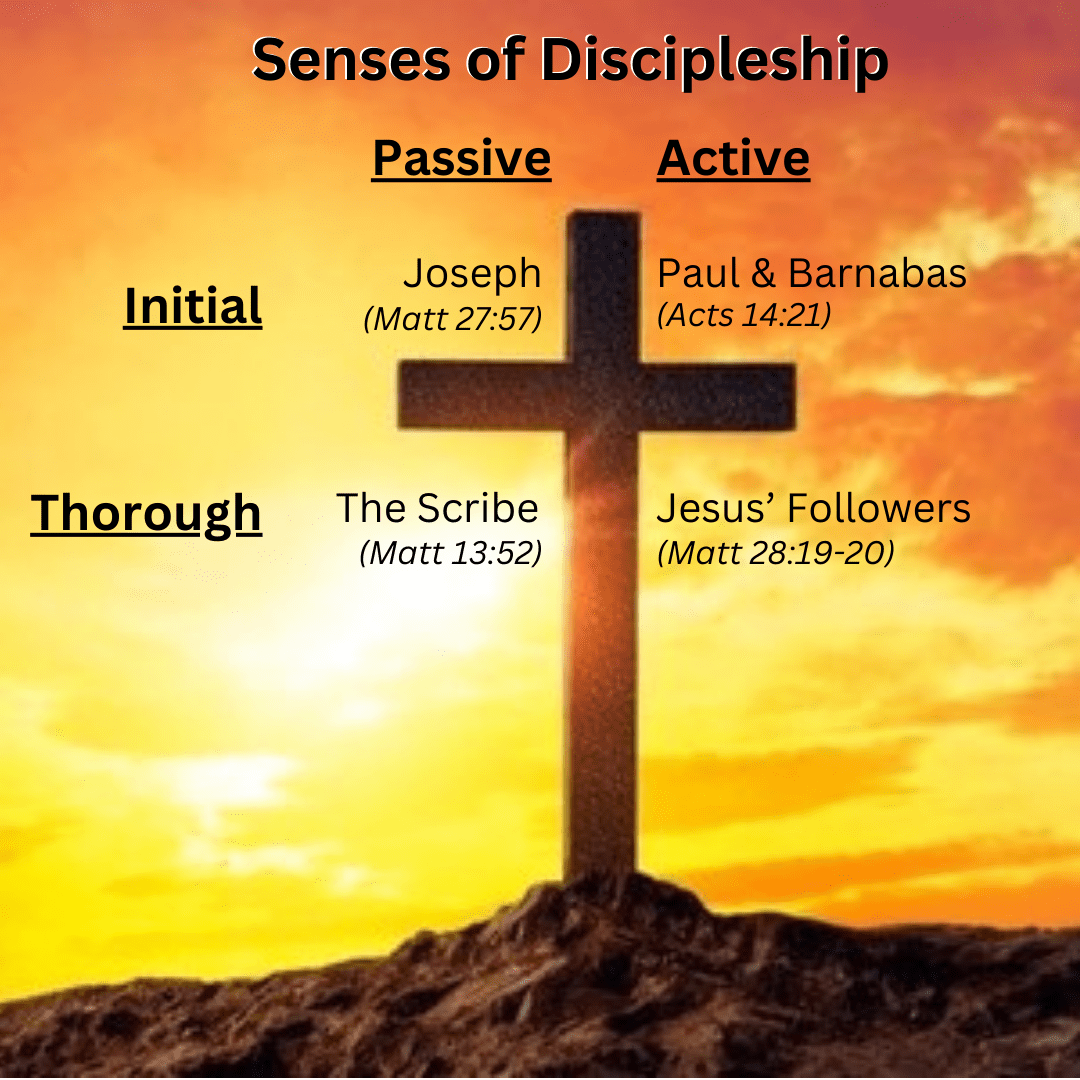
- Joseph of Arimathea had become (passive) a disciple of Jesus (apparently in the initial sense (Matthew 27:57, NIV, NASB).
- Jesus envisioned a scribe who has been (passive) trained as a disciple (in the more thorough sense) (Matthew 13:52).
- Paul and Barnabas preached the gospel in the city of Derbe and made (active) many disciples (in the initial sense)(Acts 14:21).
- Jesus instructed his followers to go make (active) disciples of all nations (including the initial but also the more thorough sense)(Matthew 28:19). In this passage “make disciples” is in the form of a command and is further defined by the two accompanying particles “baptizing them” (suggesting the initial sense of becoming a disciple) and “teaching them to observe all that I have commanded you” (suggesting the thorough sense).
(See the matrix / image at the top.)
I won’t create labels for the four ways the verb is used, because I’m already concerned that this may seem merely “neat” or “interesting” or “cute.” But to describe them, I’d say I can become a disciple (initial, passive) and grow as a disciple (thorough, passive), and then I can help others become disciples (active on my part, initial) and also help them grow to completeness in Christ (active, thorough).
The way Scripture uses the word “make disciples” is telling us something important. It tells us that the primary senses of discipleship mentioned above and that are in common use today are all important. We should not argue that there is one “correct” meaning of the word because the way it is actually used in Scripture shows a variety of nuances. I don’t know about you, but I need to remind myself to value all those senses, not just my favorite sense.
There is also an important practical application. To have balance, I need not only to have become a disciple myself but also to keep on being trained thoroughly as a disciple. Then, even before I am fully trained, I need to start helping others become disciples of Christ and then keep following up with them by helping them grow to be like Christ. Various ones of us may be better at the different aspects of discipleship, but the way the word is used in the New Testament suggests they are all important. I’m convinced we all need to be involved in all of them in at least some degree. And certainly, if we hope to have balance, our congregations need to resist the tendency to put all our focus on only one or two of the senses and instead make sure we give strong attention to all four.
May we take the word to heart. This is a wordplay. I’m referring to both the word of God and the word matheteuo (make disciples). Or better, I’m referring to the word of God contained in the word matheteuo. If we do indeed take the word to heart, there will be more disciples among us and God will be pleased.
 Empowering Subjects
One thought on “The Senses of Making Disciples”