
John 18:33-37.
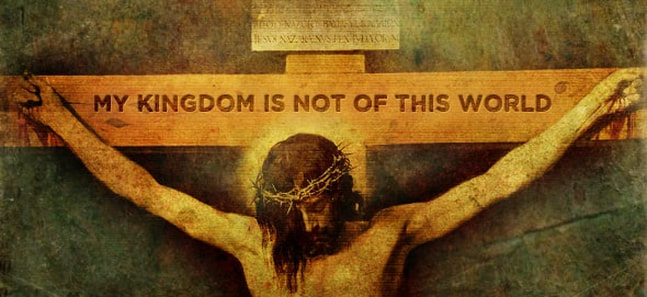
Jesus is a great King (v. 37), but his kingdom is not of this world (v. 36, twice). Rather, it is from “above,” from God (cf. John 3:3, 5; 8:23). This means God is ultimately the one who establishes and extends the kingship of Christ (Isaiah 9:7; Daniel 2:44; Mark 4:26-29). Remarkably, however, he has chosen to involve human beings in its growth as well.
So it is important for us to realize that the source of the kingdom of Christ affects its aims and means. If his kingdom were of the world, preventing his arrest would be paramount. In reality, however, his execution is foundational to his kingdom. Similarly, fighting would be an appropriate means if his kingdom were of the world. In reality, however, literal fighting has no place in his kingdom.
For God’s people living in the world, there is a perennial temptation to mix their own desires with the values of secular society and so seek goals and utilize means that are inappropriate to the kingship of Christ. The best known example is the Jews’ yearning for a military/political kingdom (John 6:15). Even though he had followed Jesus for three years, Peter still succumbed to such a desire when he drew his sword and cut off the ear of the high priest’s servant (18:10). Jesus rebuked him for this worldly approach and stated his own resolve to drink the cup his Father had given him (18:11).
Scripture shows that first century Jews also mistakenly believed the kingdom was “just for us” (i.e., Israel), and so they did not share God’s concern for other nations (Acts 1:6). Likewise they believed that the kingdom would appear immediately (Luke 19:11) and dramatically (Luke 17:20-21). Further, they believed the kingdom would be a matter of overwhelming victory. They had no room for a suffering Messiah (John 12:34).
Do any of these sound familiar? Do we seek his kingdom politically? Are we focused on a kingdom primarily “just for us?” Do we expect instant, dramatic evidence of the kingship of Christ? Do we yearn so intensely for victory that any experience of suffering makes us think something has gone wrong?
Do we ever utilize the weapons of the world to grow God’s kingdom? To be sure, not every “weapon” in the world is owned exclusively by the world. Scripture shows Jesus and his followers utilizing some technologies and insights of the world to build the kingdom of God—Roman roads, boats and ships, insights about people (John 2:24-25), principles of good communication, and hard work, to name a few. Though such things are in the world and are often used by people in the world to establish the kingdoms of the world, we can nevertheless use them for God’s purposes.
Still, we must be prayerful, thoughtful, and careful as we consider how to approach the growth of God’s kingdom. Both secular culture and even our own church culture are permeated with worldly thoughts and perspectives that are incompatible with Christ, and we are easily and subtly swayed by these to seek wrong ends and use inappropriate means.
My Kingdom is Not of this World.
A counselor once gave me a “QTIP”—quit taking it personally. It’s quite easy to get offended and respond badly when we take the words and actions of others personally when they were not meant that way. This suggests a way we can avoid pursuing wrong ends and means in growing the kingdom of Christ, only in reverse. With our Lord we need an “ATIP”—always take it personally. I thought of this because Jesus tried to move Pilate away from politics and get him to take his truth personally by asking if his notion of Jesus’ kingship was his own idea or that of others. Sadly, Pilate dodged the question (18:34-35). Jesus gave him another opportunity when he stated that he himself was a King, that he had come into the world to testify to the truth, and that “everyone who is of the truth listens to my voice” (18:37). Again, Pilate refused to hear. Instead, he closed his heart and threw up the postmodern-sounding smokescreen, “What is truth?” Jesus didn’t reply to him with words, but over the next couple days he would profoundly define truth by his deeds (John 18-20). The death and resurrection of Jesus are the ultimate truth and demonstrate that he is indeed Christ, the King. This needs to be personal to all of us.
But enough about Pilate. What about us? Are we “of the truth?” One way we can know is by the current passage. It encourages us to ask whether we are listening to Jesus’ voice about the aims of his kingdom. Are we seeking his ends or our own? Do we want a military/political kingdom? Are we seeking blessings and prosperity mainly “just for us?” Are we expecting instant, dramatic manifestations of the kingdom? Are we focused so much on victory that any suffering makes us think matters have gone wrong?
This Scripture also calls on us to evaluate whether we are of the truth by considering what weapons we use to grow his kingdom. We’ve noted that we must exclude the weapons of this world, but the passage also shows us spiritual weapons we should include. Jesus specifically mentions the importance of the spiritual weapon of “testifying to the truth” (v. 37). Since many in our day downplay telling others about the true King, we must consciously and deliberately choose to listen to him instead of them. Elsewhere Christ gave us an illustration of his counter-cultural way of bearing fruit, namely, like a seed that falls into the earth and dies (John 12:23-26). After his encounter with Pilate he also powerfully demonstrated this way by his humility, self-denial, submission, suffering, and sacrifice (John 18-20). How many times did the spiritual weapons mentioned in this paragraph come up in your last meeting or conversation about how to grow the church?
I realize the truths here are challenging and sobering. But such truth is especially needed at times like these when we are so tempted to grow our own kingdoms and utilize approaches that look more like the world than our King. The temptation to do so is both subtle and powerful, and I’m afraid I have succumbed numerous times over the years. Jesus’ words in John 18 call us to be careful, thoughtful, and prayerful about how we seek to do his work.
The simply stated truth in John 18 is vastly more profound and meaningful than we usually realize, and we must allow ourselves to be thoroughly transformed by it: “My kingdom is not of this world.”
 Empowering Subjects
Thank you for an engaging post and giving your readers something to think about….
LikeLike